
Why a writer should be in your strategy room
“This is what good writing allows us to notice sometimes. You can see the underlying essence only when you strip away the busyness, and then some surprising connections appear.”
- Anne Lamott, Bird by Bird
Good writers are trained to strip away busyness – to find the underlying human truth, remove the irrelevant detail, and kill your darlings when the story demands it.
That’s also the hardest part of business strategy.
Because the hard part of strategy isn’t writing it down. It’s getting other people to believe in it – your team, your board, your investors, your partners – so they make different decisions tomorrow than they made yesterday.
Strategy isn’t a document. It’s a shift in behaviour.
And ‘stripping away’ is at the heart of Slow Business philosophy, too. Strategy is a set of choices: what will we do to create value and compete? And just as importantly – what won’t we do? What are we prepared to give up?
That’s how you focus resources. And it’s also how you create real differentiation: by turning down the conventional wisdom in your industry – even when it’s popular. Even when ‘that’s how it’s always done.’ And especially when it clearly sucks.
Making surprising connections
Let’s take hiring.
Right now, the job search status quo is painful for both employers and jobseekers. High-volume, AI-enabled application spam wastes talent teams’ time. And jobseekers end up applying for more and more roles just to have any chance of a response.
Swipejobs flips that model. Instead of using AI to automate and filter, it becomes a magnet to pull the right job-seekers in.
This is not just about the tech. It’s the ‘underlying essence’ beneath the model – the human insight about how people behave. And that’s how Swipejobs has emerged with a consistently profitable business.
That’s quiet, intentional business growth – with a great story people believe in.
Why most strategies don’t land
Here’s how strategy often works inside organisations.
A leadership team brings in external help for a fresh perspective. After extensive research, a consultant delivers a 100-page deck packed with frameworks, charts, canvases, and careful caveats.
It might make sense financially. It might even make sense operationally.
But it doesn’t resonate emotionally. A year later, nothing has changed. Because it can’t be easily repeated, retold, and translated into everyday decisions.
I’ve seen so many strategies fail, including my own. And this is what I’ve learned: unless people understand the strategy, believe it’s worth the disruption, and feel the imperative to change… nothing changes.
Here’s the thing. If people – leaders, managers, employees, customers, investors – don’t make different choices as a result of your strategy, then you don’t have a strategy. You have a document.
So instead of treating strategy as a static deck, treat it as a story: a clear and compelling case for change.
A good strategy story makes a (sometimes surprising) connection between where we are now and where we could be – and it answers the questions people are silently asking the moment you announce a new strategy:
What is actually changing here?
What does this mean for my role, my team, my customers?
What decisions do you want me to make differently, day to day?
Strip it back until it’s sayable
There’s a reason some of the best strategy thinking argues for a single-page ‘strategy visualisation’. Not 100 slides. One page people can hold in their heads.
A clear ‘cognitive map’ helps people see how their capabilities and actions connect with strategic outcomes. And research shows simple visuals beat complex ones – because they’re easier to recall, explain, and act on.
My favourite writing constraint is the power of three:
Find the three anchor concepts that explain your strategy. Then show the cause-and-effect flow between them.
That’s a job for someone who can strip away the busy-ness and keep the meaning intact – not a designer working alone. Because the goal isn’t just something that looks good. It’s something people can repeat accurately in a 1:1, in a client meeting, in an investor call, in the coffee queue. Without you in the room.
That’s writing’s superpower.
Also, it’s true for both your external brand story, and your internal strategy story. If you can tell a great, consistent story about your brand, it’s easier to attract, convert and keep customers. If you can tell a great, consistent story about your strategy, it’s easier to align teams, win investment, build partnerships, and hire top talent.
You need both for sustainable growth.
The turning points of a strategy story
Alex M H Smith unpacks the narrative milestones of a good strategy story in his Strategy Shortcut System, and they’re useful turning points for any compelling story.
What is the status quo?
Why it sucks
The secret only you know
The thing we’re going to do to unlock this
The fantastic end state.
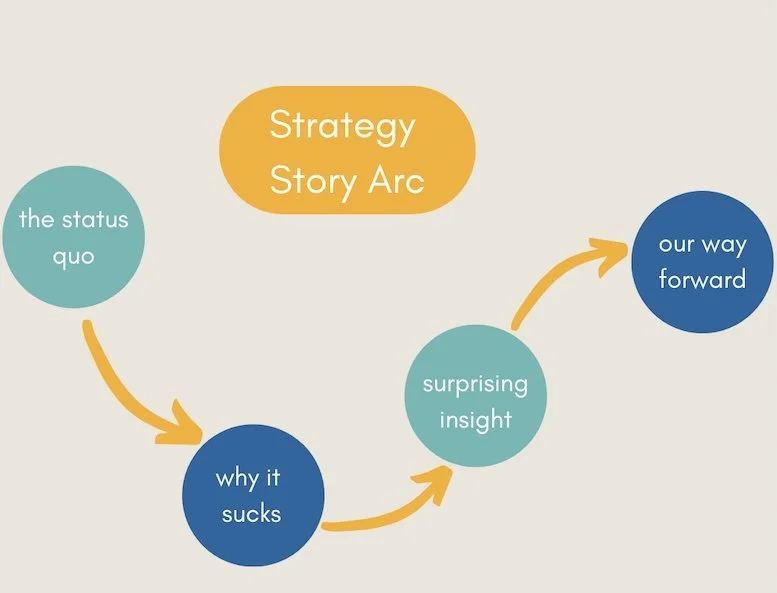
The hero’s journey as a narrative story arc
This is an emotional trajectory we all recognise – a hero’s journey, with resistance, risk, and roadblocks on the way to something better.
It resonates because the ‘why it sucks’ part is usually the underlying essence of the market. People already feel it. They just haven’t heard it named clearly.
And once it’s named, it’s like some turned on the light. We know it can be fixed. We just need to believe we can get there – together.
That’s the power of a good story – paired with a simple visual.
So before you engage another consultant to validate your thinking, consider this: do you need more analysis, or do you need a better story?
Because writers are trained to ask the uncomfortable questions, find the underlying truth, and strip away the noise. And then turn it into a story people can remember, retell – and act on.
I’ve spent 20 years working at the intersection of strategy and story. If this resonates, and you’d like a writer in your strategy room, I’d love to hear from you.
Originally published on Substack
